
Disney World Crowd Calendar 2026: Best and Worst Weeks
Month-by-month Disney World crowd guide for 2026. Find the least crowded weeks, park-by-park breakdowns, and the dates to avoid entirely.
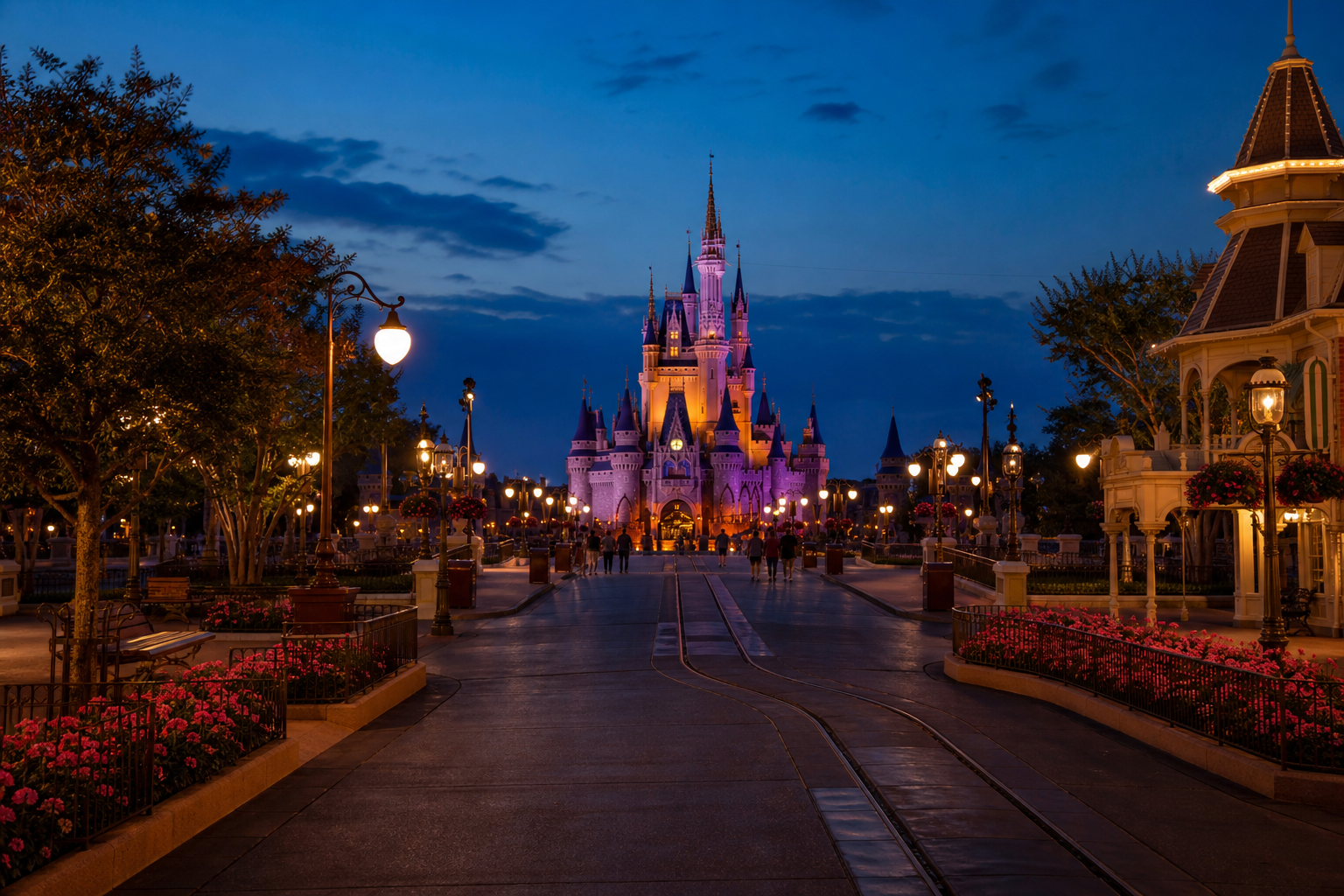
Disney World Crowd Calendar 2026: Best and Worst Weeks to Visit by Park
The least crowded weeks at Disney World in 2026 fall in mid-January (after January 7), late August through September, and the first two weeks of May. The busiest stretches are the week between Christmas and New Year’s, spring break (mid-March through early April), Independence Day week, and the fall break window in mid-October. Knowing these windows before you book can save you hours of wait time per day — and potentially hundreds of dollars on resort rates.
Planning a Walt Disney World vacation without checking crowd levels first is like packing for a road trip without checking the weather. We track these patterns closely for our clients at Vacations by Kelly, and the single most common regret we hear from first-time visitors is, “We didn’t know it would be that crowded.” This guide pulls together 2026-specific data so you can make a confident, informed decision before you lock in your dates.
Why Crowd Levels Matter More Than Ever
Disney World is a massive operation — four theme parks, two water parks, and a resort complex covering roughly 25,000 acres. Even so, capacity has limits. When the parks run at or near capacity, Lightning Lane queues stretch past the hour mark, standby lines for headliners like Tron Lightcycle / Run or Guardians of the Galaxy: Cosmic Rewind push two to three hours, and even a well-planned day can feel like an exercise in damage control.
Crowd levels also affect price. Disney uses demand-based pricing for park tickets and Lightning Lane Multi Pass. A day that historically draws a crowd score of 9 out of 10 can cost $50 to $70 more per ticket than a low-demand day in September. Choose wisely and you’re essentially buying back your vacation.
2026 Disney World Crowd Calendar: Month-by-Month Breakdown
January 2026
Best weeks: January 7–31
Worst days: January 1–6 (New Year’s hangover crowds)
The first week of January routinely logs some of the highest crowd scores of the entire year — residual holiday traffic from Christmas week hasn’t fully cleared, and families squeeze in one final vacation push before school resumes. After January 7, however, the parks empty out dramatically. From January 8 through the end of the month, you’ll find crowd scores consistently in the low-to-moderate range. Wait times for headliners drop by 40–60% compared to the holiday peak.
One event to note: the EPCOT International Festival of the Arts kicks off January 16, 2026, and runs through February 23, 2026, according to the Disney Parks Blog. The festival is included with regular EPCOT admission and adds genuine value to a low-crowd visit — interactive art installations, the Figment scavenger hunt, and the Disney on Broadway concert series make EPCOT worth a full day even in winter.
Our take: Mid-to-late January is the single best month of the year for adults and families without school-age children. We’ve booked clients into this window repeatedly and the consistent feedback is that it feels like a different park.
February 2026
Best weeks: February 3–13, February 24–28
Worst days: Presidents Day weekend (February 14–16)
February is broadly a low-crowd month with one notable exception: Presidents Day weekend sends a significant surge through all four parks. School districts across the country observe a winter break aligned with Presidents Day, and Disney World absorbs that traffic fully. Avoid February 14 through 16 if you can.
The first two weeks of February are excellent. The Festival of the Arts is still running at EPCOT through February 23, and park hours are typically shorter (9 AM to 9 PM at Magic Kingdom versus 9 AM to midnight in summer), which means more manageable crowds and cooler temperatures in the mid-60s to low 70s Fahrenheit.
March 2026
Best weeks: March 2–7
Worst days: March 14 through April 5 (spring break peak)
March is a split month. The first week carries relatively modest crowds — Florida’s spring break hasn’t hit yet, and northern schools are still in session. After March 14, the picture changes entirely. Spring break is one of the two or three busiest windows of the entire year. Multiple school systems — Northeast, Midwest, Texas, and Florida — stagger their breaks across mid-March through early April, creating a rolling crush that keeps all four parks packed for nearly three consecutive weeks.
The EPCOT International Flower and Garden Festival launches March 4, 2026, and runs through June 1, according to the Disney Parks Blog. The topiaries, outdoor kitchens, and live entertainment at EPCOT are genuinely beautiful this time of year — but they also draw their own audience on top of the spring break base crowd.
Verdict: Visit the first week of March if you must travel in this window. Otherwise, hold off.
April 2026
Best weeks: April 19–30
Worst days: April 3–5 (Easter weekend), April 1–18
Easter Sunday falls on April 5, 2026. The two weeks surrounding Easter rank among the busiest of the year, with crowd scores regularly hitting 8 to 9 across all four parks. The second half of April quiets down considerably. Once most spring break windows close, crowd scores retreat to the moderate range (4 to 6), and the Flower and Garden Festival is still running at EPCOT with less of the spring break audience.
May 2026
Best weeks: May 10–20
Worst days: Memorial Day weekend (May 23–25)
May is one of the most underrated months on the calendar. After the April spring break crowds clear and before the summer surge begins in earnest, the second and third weeks of May offer some of the best value in the entire year. Temperature is climbing but not yet brutal, the Flower and Garden Festival wraps up June 1, and park hours start to extend without the full summer crowd to fill them.
Memorial Day weekend is a hard stop — Friday through Monday of that holiday weekend brings significant crowds across all four parks. Build your itinerary to be out of the parks before Thursday, May 21, or arrive after Tuesday, May 26.
June 2026
Best weeks: June 2–12
Worst days: Late June (June 22–30)
Summer begins in earnest in June. Florida public schools let out in early June, and families from across the country start their Disney World pilgrimages. The first week or two of June still carries lower baseline crowds than July — many out-of-state schools haven’t released yet. By the third week, summer rhythm is fully established.
Crowd patterns in summer show twin peaks: one around late June and one in late July, as the season reaches its “last hurrah” before back-to-school. Mondays in summer are consistently the worst day of the week at all four parks — Florida annual passholders and weekend travelers concentrate on Monday, creating a compounding effect. Plan your Magic Kingdom visit on a Tuesday or Wednesday whenever possible.
July 2026
Best weeks: July 8–17
Worst days: Independence Day week (July 1–7), late July (July 25–31)
July is the peak of peak season. Independence Day week is one of the five or six busiest stretches of the year, with fireworks at Magic Kingdom drawing massive crowds on July 4 specifically. The middle of July offers a brief respite — crowd scores dip to the moderate-high range before climbing again in the final week.
If July is your only option, target a mid-week arrival (Tuesday or Wednesday), rope-drop the parks when they open, and use Lightning Lane Multi Pass strategically for Tron, Guardians, and TIANA’S Bayou Adventure. Expect two-plus hour standby waits for top attractions at Magic Kingdom on any given weekend in July.
August 2026
Best weeks: August 10–31
Worst days: August 1–9 (last week of summer for many families)
August contains one of the best-kept secrets in Disney World planning: the back half of the month. Florida public schools return to session in early August — some districts as early as August 5 — which means local families pull out of the parks almost overnight. Out-of-state families follow in the second and third week of August as northern school districts also restart. By mid-August, crowd scores across all four parks can drop to 3 to 5 out of 10, levels you won’t see again until January.
Yes, it is hot. Florida in August means heat indices in the 100–105°F range by midday. But if you’re comfortable with a midday resort break and evening park sessions, late August at Disney World offers some of the lowest wait times of the year.
The EPCOT International Food and Wine Festival opens August 27, 2026, and runs through November 21, 2026, per the Disney Parks Blog. The final days of August combine the festival’s opening with the year’s lowest crowds — an unusually strong combination.
September 2026
Best weeks: September 1–30 (entire month, excluding Labor Day weekend)
Worst days: Labor Day weekend (September 5–7)
September is our top recommendation for families with flexible school schedules, adults celebrating anniversaries or birthdays, and anyone who prioritizes short wait times over perfect weather. Crowd scores stay in the 2 to 5 range for most of the month. We’ve had clients walk onto Seven Dwarfs Mine Train with a 15-minute wait in mid-September — a ride that typically runs 60 to 90 minutes in peak season.
Weather is still warm (average highs in the high 80s to low 90s°F) with afternoon thunderstorms that typically pass within the hour. The Food and Wine Festival is in full swing at EPCOT. Park hours are shorter than summer, but for lower-crowd visitors that simply means less walking.
Labor Day weekend is the one exception — the holiday drives a brief surge, typically lasting Friday through Monday. Arrive September 8 or later to avoid it entirely.
October 2026
Best weeks: October 1–8
Worst days: October 9–18 (fall break), October 31 (Halloween)
October has become one of the most complicated months to plan around. The first week is excellent — the Food and Wine Festival is at EPCOT, crowds are moderate, and temperatures are finally dropping into the comfortable 80s°F. Then fall break arrives.
Mid-October fall break has emerged as one of the biggest crowd events of the year at Disney World, with scores spiking to 8 and 9 across all parks on peak days. Many school districts, particularly in the Southeast and Mid-Atlantic, now observe a full week off in October, and a significant percentage of those families head to Walt Disney World. If you’re planning an October trip, the first week is your window.
November 2026
Best weeks: November 3–18
Worst days: Thanksgiving week (November 22–29)
The first three weeks of November are strong options for a Disney World visit. Crowds settle into the moderate range (4 to 6), temperatures are ideal — highs in the mid-70s to low 80s°F — and the parks begin their holiday transformations. Mickey’s Very Merry Christmas Party at Magic Kingdom typically begins in early November, which does add a ticket-surcharge event to some evenings, but the overall park remains manageable on non-party days.
Thanksgiving week is non-negotiable to avoid. The Wednesday before Thanksgiving through Sunday consistently logs the highest average crowd scores of any multi-day stretch outside of the Christmas-to-New Year’s window. Crowd scores of 9 and 10 across all four parks are the norm.
December 2026
Best weeks: December 1–18
Worst days: December 19–31 (the worst stretch of the year)
Early December is a hidden gem. The holiday decorations are fully installed across all four parks, Mickey’s Very Merry Christmas Party is running, EPCOT’s Festival of the Holidays is underway, and crowds are still manageable through December 18. This window — the first three weeks of December — offers the rare combination of full holiday atmosphere and moderate wait times.
Then December 19 arrives and everything changes. From December 19 through January 1, Disney World operates at or near capacity almost every day. The week of December 26 through January 1 is the single busiest stretch of the entire year, bar none. Crowd scores of 10 are common across all four parks simultaneously on days like December 26, December 27, and December 31. This is when Disney extends park hours until midnight or later — and it is still overwhelmingly crowded.
If a holiday visit is essential, early December delivers the Christmas magic without the holiday-week chaos.
Park-by-Park Crowd Breakdown
Different parks absorb crowds differently. Here’s how each behaves on any given day:
| Park | Average Crowd Level | Peak Days | Best Day of Week |
|---|---|---|---|
| Magic Kingdom | Highest of the four | Mondays, Saturdays, holidays | Tuesday or Wednesday |
| EPCOT | Moderate; spikes during festivals | Festival Saturdays, holidays | Weekdays, especially Thursday |
| Hollywood Studios | Moderate-high; steady demand for Star Wars and Toy Story areas | Mondays, Saturdays | Midweek |
| Animal Kingdom | Lowest of the four | Mondays in summer | Any weekday; closes earliest (6–8 PM) |
Magic Kingdom consistently logs the highest attendance of the four parks because it carries the broadest appeal — young children, first-time visitors, and fans of classic Disney attractions all converge here. When crowds are high park-wide, Magic Kingdom feels it most. Rope-dropping by 8:45 AM and hitting Tron Lightcycle / Run and Seven Dwarfs Mine Train before 10 AM is the most effective single strategy we’ve used with clients.
EPCOT benefits from its festival calendar. During the Flower and Garden Festival (March–June) and the Food and Wine Festival (late August–November), EPCOT adds programming that spreads guests across World Showcase rather than concentrating them at the front of the park. On non-festival Saturdays it can become surprisingly crowded at Guardians and Test Track.
Hollywood Studios is anchored by two crowd magnets — Star Wars: Galaxy’s Edge and Toy Story Land — that reliably drive long standby waits. The park is relatively compact, which amplifies the crowded feeling. We recommend an early arrival and Lightning Lane Multi Pass prioritized toward Slinky Dog Dash and Star Wars: Rise of the Resistance.
Animal Kingdom is the easiest park to have a great day even during moderate crowds. Its earlier closing time (typically 6 to 8 PM) means lighter evening traffic, and the layout across multiple themed lands spreads guests naturally. Expedition Everest and Avatar Flight of Passage are the two headliners that need Lightning Lane attention.
The 6 Best Weeks to Visit Disney World in 2026
Based on the month-by-month data above, here are our top six windows ranked by overall value (low crowds + reasonable weather + strong park programming):
- September 8–30 — Lowest sustained crowd scores of the year; Food and Wine Festival at EPCOT
- August 13–26 — Second-lowest window; heat manageable with midday breaks
- January 8–31 — Cool weather, minimal waits, Festival of the Arts opening Jan 16
- May 10–20 — Flower and Garden Festival still running; crowds near annual low before summer surge
- December 1–18 — Full holiday decor, manageable waits
- February 3–13 — Low crowds, Festival of the Arts, pleasant temperatures
The 5 Worst Weeks to Visit Disney World in 2026
Avoid these windows unless you have no alternative — and if you must go during them, budget extra for Lightning Lane Individual and set your alarm for pre-park-opening rope-drop.
- December 19–January 6 — The single worst stretch of the year, every year
- March 14–April 12 — Spring break rolling surge
- Thanksgiving week (Nov 22–29) — Crowd scores matching holiday week levels
- July 1–7 — Independence Day week
- October 9–18 — Fall break; increasingly the fifth-worst window of the year
Tips for Any Time of Year
No matter when you visit, a few principles hold regardless of crowd level:
Arrive before the park opens. The first 90 minutes after rope-drop are consistently the lowest-wait window of any day. We’ve ridden three headliners in the time it takes most mid-morning guests to get through one.
Skip Mondays if you can. Saturdays and Mondays are the busiest days of the week at all four parks. If your schedule allows, build your theme park days around Tuesday through Thursday.
Use Lightning Lane Multi Pass strategically. Purchase it as early in the day as possible and book your first selection before you enter the park (you can book starting at 7 AM if staying at a Disney resort, up to 7 days out for your stay; off-site guests can also book at 7 AM, starting 3 days before their visit). Prioritize it toward headliners with the highest standby times.
Build in a midday break. Crowds at the park gates surge between 10 AM and 2 PM as late arrivals file in. Returning to your resort for lunch and a rest — then heading back for the 4 to 5 PM crowd lull — is one of the most effective strategies for any visit, regardless of season.
Check the EPCOT festival calendar first. The four annual EPCOT festivals (Festival of the Arts, Flower and Garden, Food and Wine, Festival of the Holidays) add significant value to any EPCOT day at no extra cost. Aligning your visit with a festival opening week — before the crowds build — is a strategy worth planning around.
Final Word
The difference between a great Disney World trip and an exhausting one often comes down to timing. The data is clear: late August and September offer the lowest sustained crowd levels of 2026, while the two-week window between Christmas and New Year’s is the single most challenging stretch you can walk into. Wherever your date constraints fall, use this guide to find the best window within them — and if you’re still weighing options, we’re happy to help you map out the ideal itinerary.
Our clients consistently tell us that a well-timed Disney World trip, even during a moderate-crowd week, feels like a completely different park from the one they struggled through on an unplanned holiday visit. The magic is there year-round. The strategy is knowing when to show up.
Related Posts
Disney World Rider Switch Explained: How Both Parents Ride Everything
Read more
EPCOT With Toddlers: Yes, It's Worth It — Here's the Right Way to Do It
Read more
Disney World Just Gave Three Major Rides a Holiday Glow-Up — and the Muppets Are Leading the Charge
Read more